Posts

THERE WILL BE TEARS!
Image
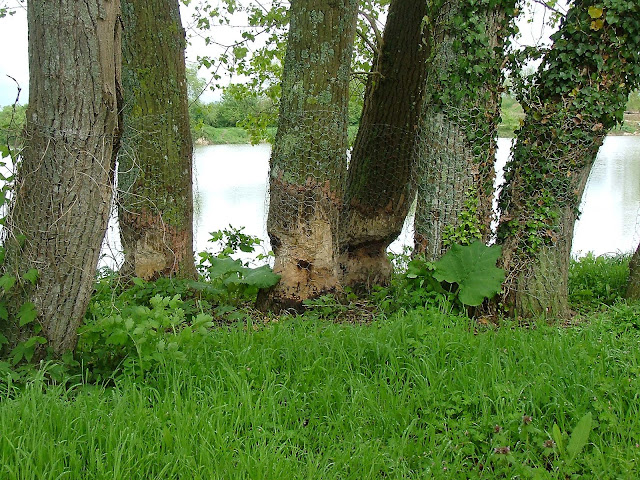
       Poplar trees in France protected (belatedly) from Beavers. Wildlife conservation these days has moved away from the “reserves” mentality onto a broader picture of re-introductions and re-wilding. But this brings “nature” closer to a wider spectrum of the public. “Nature” is no longer confined to a “reserve”. It is out there in the wider countryside. One may meet Cranes, Water Voles, and Beavers amongst others.  “Coming to a woodland near you – Wolves!” But those Wolves require quite a large territory to maintain them, and that to be far enough away from farmed habitat not to be a nuisance to livestock farmers. The same would apply to Beavers. So alright; they are not “top predators”. They are vegetarians. But they are still going to be in competition for fodder with grazing livestock.   I’ve seen in France the trails into riverside crops of maize they make. And the breaking down of riverbanks, and diversion of streams. So while these re-intr...

RUNNING TO WASTE.

Image
When I came to live in East Cornwall it was inevitable that I would become interested in geology and industrial archaeology. I am surrounded by the remains of all the mining history which made Cornwall famous throughout the world. Walking the “grass” over the surface of these long-abandoned works the evidence stretches far and wide. Not least among these disturbances is the miles of leats, channeling water off the moor or from the streams to provide power for hauling, winding, stamps, etc. Although steam was used, the fuel, coal, would have been shipped across the Bristol Channel to North coast ports. Our presently wooded valley sides would have been denuded of anything combustible early on. There was competition from the tanning industry and for timber. So water power was an integral part of the process. In the Tamar Valley, near Luckett, leats collect water from side valleys and channel it to wheels at several levels, up to 300ft. above the River. Water from the higher levels wou...

WHAT'S IN A NAME: II

Image
 I’m getting cranky in my old age. (Not that I feel old, except when I have to get up off my knees!) So I get annoyed with some aspects of language. I have always enjoyed the English language; it’s the only one I’m reasonably fluent in. I like the way that there is always the right word to use for everything (as long as one can remember it!). And it is evolving all the time to be able to keep pace with our changing society. One sees in the media (principally the written media) from time to time that new words or terms have been added to the Standard Oxford Dictionary. For a long while in our history the “media” was only written. Then came radio, then TV and now “social media”. So changes have accelerated. One would expect that with this increased distribution of news, ideas, language, our vocabulary would have expanded enormously. But I venture to suggest it has not. So now we have “woke”. I’m not sure what that is exactly, so I guess I’m not it! But how many of you are famil...

I must be batty!

Image
  End of 2020 National Bat Monitoring Programme. (NBMP)   That’s another season done! The last of the NBMP surveys is the Waterways Survey in the first and second halves of August each year. This survey counts the number of Daubenton’s Bat passes, as heard on a bat detector, as one stands beside the water, for each of 10 four-minute periods along a kilometre of water, be it lake or stream or river. One of the characters of Daubenton’s Bats is that they feed by skimming the surface of water, picking off insects that are emerging from the water or just hovering over it. (When seen on an infra-red night-sight they look like ice skaters.) By counting the number of passes at each station along the bank one gets an idea of how many bats are feeding in the area. So year on year one builds up a picture of the population changes for this bat.     A typical section of the Tamar where I record. I do three sites for this survey; two on the River Tamar which separates Cor...