Posts

RECORDING – WHAT’S THE POINT?

Image
 Biological recording should be more than collecting train numbers, shouldn’t it? For some it starts as a compulsion to make lists. For others it may be the need to name something. Good reasons, but why not make it “valuable”. Worth doing for the sake of science, or someone else’s interest, or conservation. ADD VALUE by sharing what you record! Pass your records to the County Recorder. Or put them on a database. Or send them to the local records centre. To be of any interest to anyone else a basic biological record must have the four basic components: WHO – WHAT- WHERE – WHEN. The WHO tells everyone which person “collected” the record. It is a person or organisation that one can go back to to query the record, or elaborate it. When it comes to the verification of data on a database, it gives the authority doing the verification an idea of how reliable the record is if it is a known person or group. The WHAT tells us a species or genera name. Unless a biological group has a ...

Phenomenon

Image
  PHENOMENON: strictly “..any event that is observable.” (Wikipedia) Common usage “..most commonly used to refer to occurrences that at first defy explanation or baffle the observer.” (Wikipedia) Keen natural historians go through life observing the wonders of nature. Day by day we see “life” happening before us; the passing of the seasons; life cycles of animals and plants; the feeding; the mating; the changes of form or size. We find wonder and enjoyment in all the changes as they occur. Some of it we understand; much of it is still a mystery. But every now and again, something happens which takes us completely by surprise. Something which we have never seen before; possibly never heard of; possibly heard of but never witnessed. Some “event” which we may have guessed at , or realised must take place but never seen. A “natural phenomenon”! Some years ago Mary and I were on a conducted birding holiday in Romania and part of the trip was living on a boat and cruising t...

THERE WILL BE TEARS!

Image
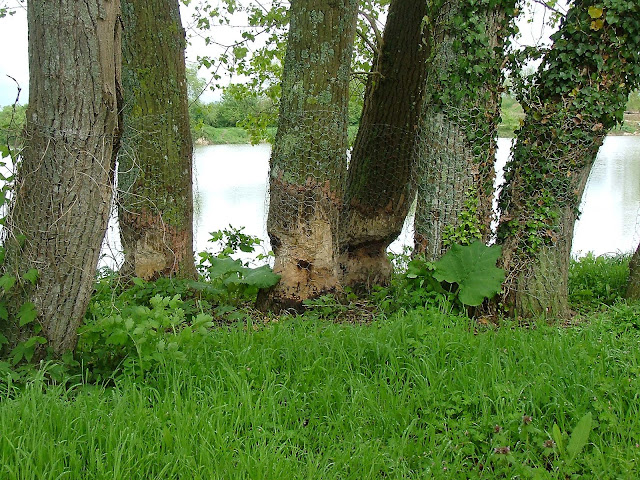
       Poplar trees in France protected (belatedly) from Beavers. Wildlife conservation these days has moved away from the “reserves” mentality onto a broader picture of re-introductions and re-wilding. But this brings “nature” closer to a wider spectrum of the public. “Nature” is no longer confined to a “reserve”. It is out there in the wider countryside. One may meet Cranes, Water Voles, and Beavers amongst others.  “Coming to a woodland near you – Wolves!” But those Wolves require quite a large territory to maintain them, and that to be far enough away from farmed habitat not to be a nuisance to livestock farmers. The same would apply to Beavers. So alright; they are not “top predators”. They are vegetarians. But they are still going to be in competition for fodder with grazing livestock.   I’ve seen in France the trails into riverside crops of maize they make. And the breaking down of riverbanks, and diversion of streams. So while these re-intr...

RUNNING TO WASTE.

Image
When I came to live in East Cornwall it was inevitable that I would become interested in geology and industrial archaeology. I am surrounded by the remains of all the mining history which made Cornwall famous throughout the world. Walking the “grass” over the surface of these long-abandoned works the evidence stretches far and wide. Not least among these disturbances is the miles of leats, channeling water off the moor or from the streams to provide power for hauling, winding, stamps, etc. Although steam was used, the fuel, coal, would have been shipped across the Bristol Channel to North coast ports. Our presently wooded valley sides would have been denuded of anything combustible early on. There was competition from the tanning industry and for timber. So water power was an integral part of the process. In the Tamar Valley, near Luckett, leats collect water from side valleys and channel it to wheels at several levels, up to 300ft. above the River. Water from the higher levels wou...